
Finer Meditations
Poetic Evocations From Our Green and Pleasant Friends

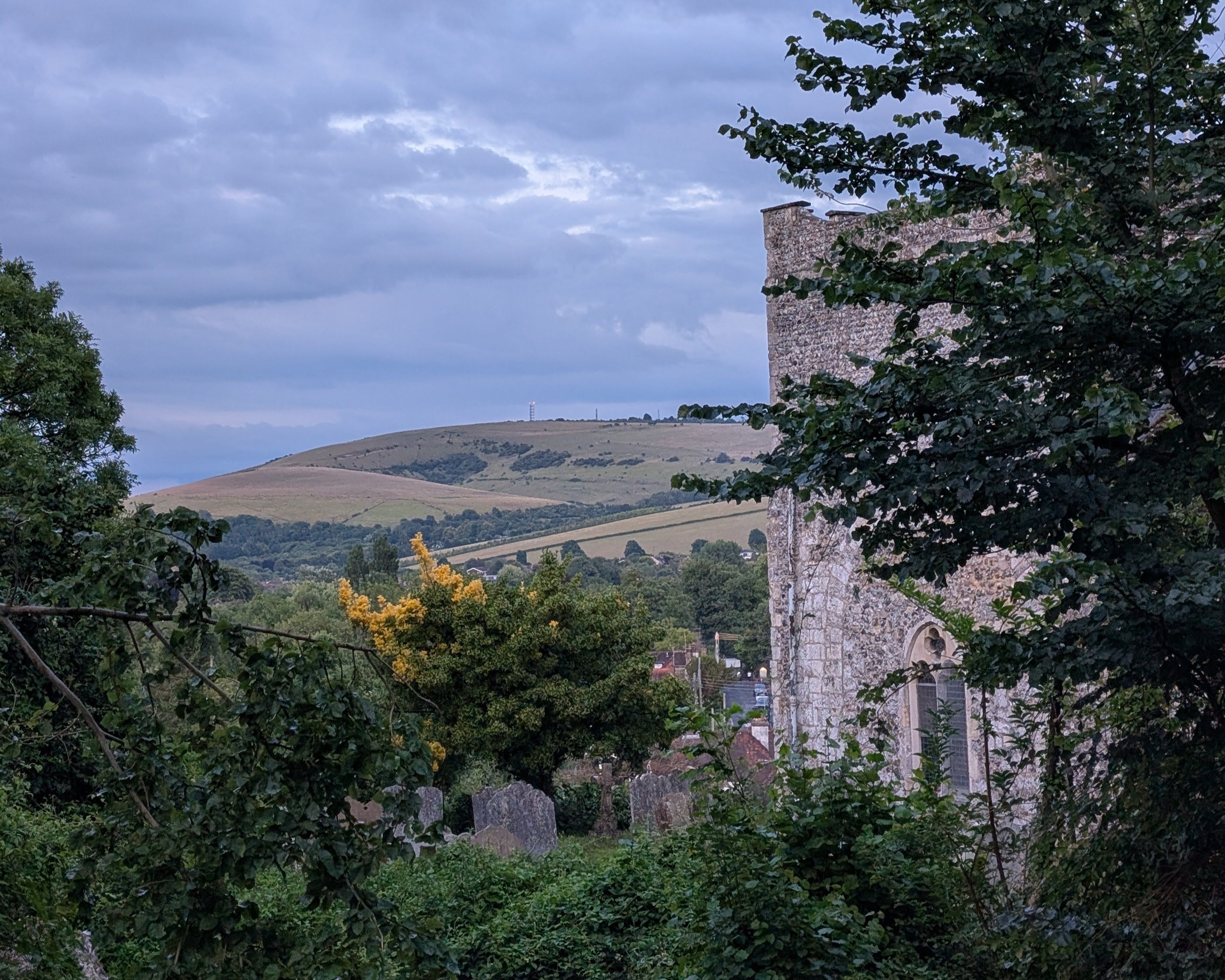
“Rolling acres of botanical tapestry.” My first view of the Sussex South Downs.
My first visit to England occurred in July, and while the main purpose was to spend time with some great friends, it also turned into a geography lesson about Sussex. One of our hosts grew up around Brighton, so we received native-level knowledge about everything we saw. I was introduced to not just general facets of English life, such as walking paths that meander through both public and private land and how drivers navigate narrow roads with looming hedgerows, but also to the South Downs and to the south coast.
Our friends walked us around their community to show us their High Street, surrounding wetlands, a church and cemetery, and the remains of a castle. Our Sussex native provided commentary about it all, with additional asides from her American-born husband who had now lived in England longer than in Chicago.
My immediate feeling of kinship with the rolling Sussex landscape could be due to many days spent in northwest Illinois and southwest Wisconsin. This part of the Midwest is known as the Driftless Area due to the fact that the last glacier missed scraping this part of North America clean of rocks and hills. Featuring undulating green and outcroppings of rock rather than just flat and more flat, driftless land likely reminded settlers from Europe of areas like Appenzell and Bavaria, much like the Dutch must have felt right at home on the west coast of Michigan.
So I was thinking about nature and geography when we visited a bookshop in Steyning and I bought nature writer John Lewis-Stempel’s A Natural History of England, with its lovely lightest-pink-ever cover!
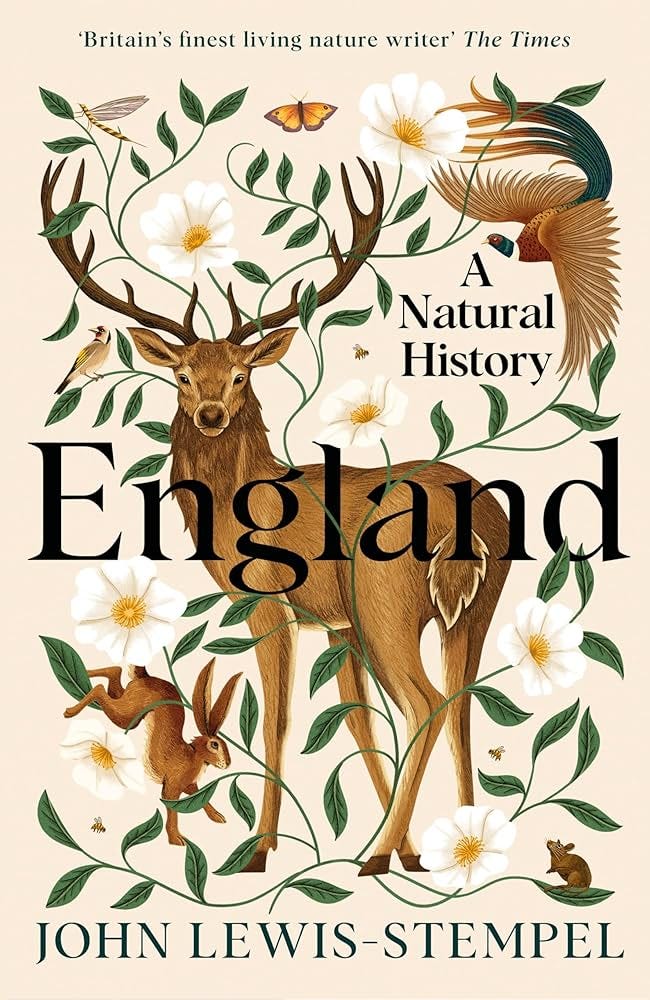
Leafing through Lewis-Stempel’s book, I could already see he was a lyrical sort, and had included a chapter on the South Downs.
“Odd how stone poverty makes floral riches,” he states, as a way to sum up what he has just told us about the South Downs. Long story short, a primeval ocean once covered the area, leaving behind an incalculable assortment of what he calls a “necropolis of poor small things” that compacted into chalk.
Lewis-Stempel possesses not just the patience to sit and listen when in nature but an imagination that can make you believe you, too, have heard a skylark and will remember its “torrential trills.” Then he tells you that these trills are actually many distinctive sung phrases and are biologically aided by the structure of the bird’s windpipe. He fills in the zoology with history, recounting how the bird went from being shot in mass quantity for its feathers or to be baked in a pie to an early entrant into England’s protected bird catalog.
While I have not yet taken to birding myself, Lewis-Stempel maintains his lyricism when he moves on to wildflowers, which have the advantage of remaining still during identification. His description of the oh-so-English-sounding squinancywort as a “waxy perennial” and the “radiant blue flower” of the milkwort give me flower envy. “There are times,” he writes, “with the heat from the ground rising, when the crushing of earth underneath the feet is intoxicating, and the Downs are a perfumed arcadia.” Not only is he selling Sussex, but Lewis-Stempel is convincing me that my growing need to stop walking through woods and start sitting in them, watching and breathing, is a good idea. Like forest bathing, but focused out rather than inward.
Getting to know the land in another part of the world is also a good reminder that your first nature is your backyard. Lewis-Stempel devotes a chapter to the tree cathedral that is London’s Richmond Park, with pages on the mighty oak. Here is a tree that I can admire locally, guided by Chicago place names like Oak Park, Oak Forest, Oak Lawn, and Burr Oak Avenue. Oak is one of the leaves I know immediately, and one of the trees that I mourn when they are lost.
Getting to know trees better by their leaves and bark is a constant goal of mine, and something that, like birding, seems to get more important as one ages. Teen-aged me was bored by trees that all looked alike and spent six midwestern months as black gnarled fingers against grey skies. The elm epidemic that wiped out so many trees in the neighborhood I grew up in did not help, as my developing self saw so many trees lost to disease that they started to look like nuisances rather than crucial neighbors. Louis-Stempel also recalls this time: “The sound of the summer of 1976? The Sex Pistols singing ‘Anarchy in the UK’ and chainsaws, which my father suggested were remarkably similar.”
I think people are becoming more aware that ecosystems are delicate balances where every living thing has a place and purpose. We know trees communicate, a notion that would have been laughable in the 1980s but seems to make more sense as we deal with the consequences of our grave mistreatment of our planet. Trees also have relationships with fungi, bugs, and animals that, when altered or disrupted, can mean havoc or worse for us.
As our knowledge grows, so does our human need to find kinship in mushrooms or ladybugs or prairie plants. Many of us have a favorite tree, and mine is the catalpa. A real urban tree, catalpas do not girth out like an oak but do sprout long cigar-like seed pods and massive leaves.
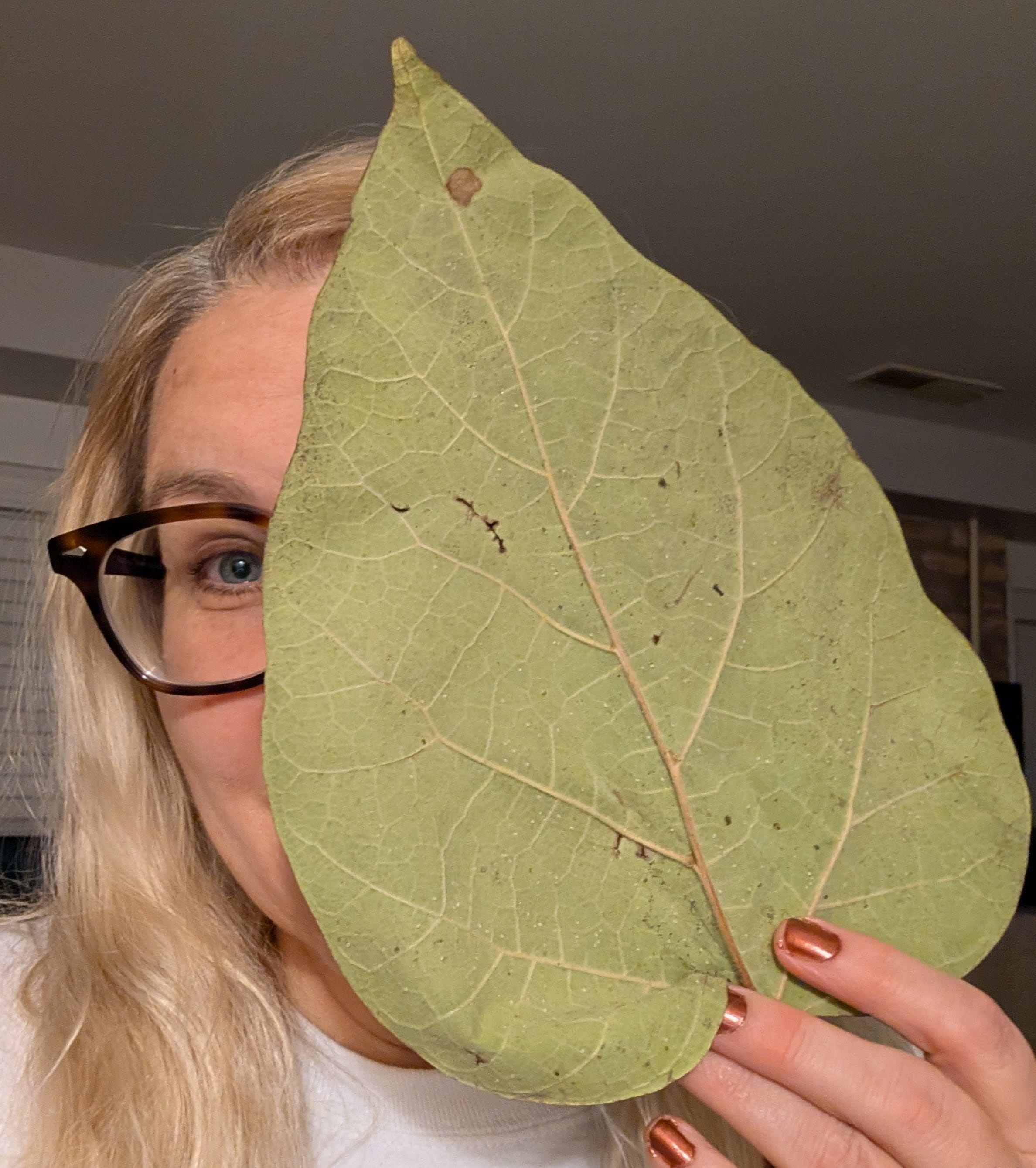
A leaf that doubles as a masquerade accessory.
We did not have catalpas in our suburban neighborhood, but relatives who lived in more urban areas did, and as a child I was fascinated by the seed pod. I took one home and with the help of my father planted the catalpa in our front yard.
Now it’s the humongous leaves that thrill me almost as much as the seed pods. My current neighborhood features catalpa as well as hawthorn, horse chestnut, basswood, Kentucky coffee, hazelnut, and Japanese maple. I know enough about trees to curse the Bradford pear (banned in many places for being invasive, weak, and stinky). I recognize other invasives, such as ailanthus, aka Tree of Heaven, because of how fast it grows, but retain a soft spot for it because it reminds me that my father taught me a lot about trees and that I eventually paid attention.
While not all reviewers were as pleased with Lewis-Stempel’s book as I am, I find in him a compatriot in that he is a curious gardener/farmer rather than a botanist. I do not need to know the kingdom, order, family, and species of what I observe, and I am more interested in the source of a living thing’s scientific name than where it falls in a taxonomy. Some books that I have looked to for guidance on plants and flowers include descriptions so formally objective that I don’t recognize that the words describe the plant right in front of me.
There is no one way to write about the natural world, nor is there one best way. In Lewis-Stempel’s words, however, I found both a kindred perspective and a nudge to do better. In Sussex, I was blessed with guides who gave us troves of information in kind of a running commentary that turned into wonderful conversations threaded through our week-long visit. Thankfully, I discovered a book that in a way continued that conversation and will help me be my own guide to the wider world and to my backyard.